
21 October 2026
Safe Bodies, Strong Voices: Body Safety at Explorers
What body safety looks like at Explorers, what your child will explore during Body Safety Week and simple ways to keep the conversation going at home.
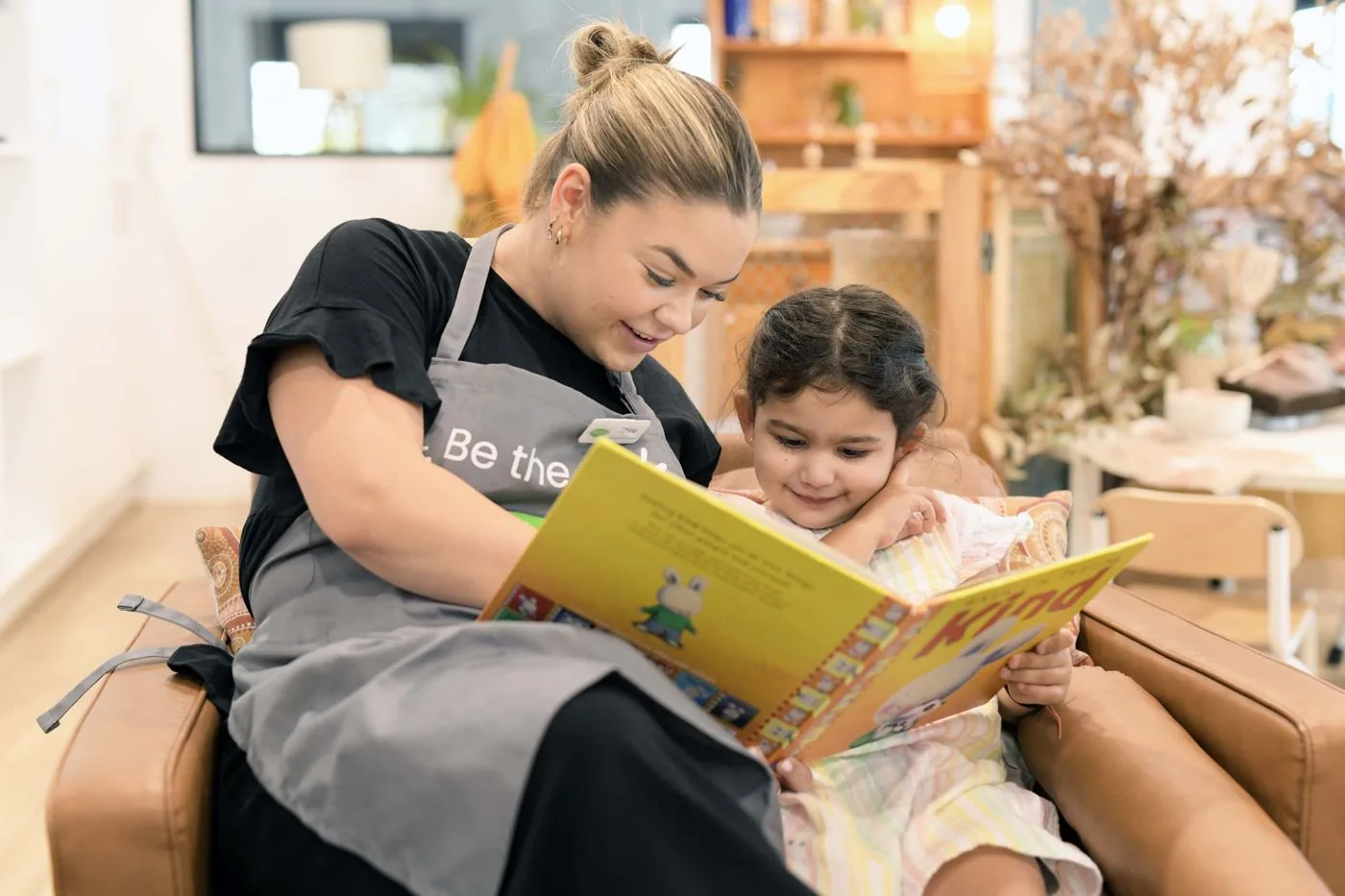
“Can I give dolly a hug?” It’s a small question, asked gently in a baby room on an ordinary morning. But it carries a big idea: that every body belongs to the person inside it and that their answer matters.
At Explorers, body safety isn’t a lesson we tick off once a year. It’s woven through everyday moments, from how we ask before a nappy change to the stories we share at group time.
This week, from 19 to 23 October, every centre is celebrating Body Safety Week: five days of stories, songs, movement, art and conversation that put children’s voices front and centre. Here’s what body safety means, what your child will explore and how you can support their learning at home.
What is Body Safety?
Body safety education teaches children their right to body autonomy: the simple but powerful idea that their body belongs to them. It also helps them recognise and respond to touch or situations that don’t feel safe.
Our Body Safety Program is built around five key ideas:
- Body ownership and boundaries: my body belongs to me and I can say yes, no or stop
- Safe and unsafe touch, plus knowing it’s always okay to tell
- Feelings and emotions, so children notice when something feels wrong
- Trusted adults: the safe people children can go to with any worry
- Secrets vs surprises
Why We Start So Young
Like healthy eating, body safety is a life skill. The earlier children learn, the more confident they’ll be in speaking up and protecting their rights.
Violence against children is a significant issue in Australia that often isn’t talked about openly. Body safety education gives children the words, the confidence and the trusted relationships they need to speak up. It also helps every adult around them champion children’s rights.
Everything we do is age-appropriate and guided by the Victorian Early Years Learning and Development Framework, the Victorian Child Safe Standards and the UN Convention on the Rights of the Child. Experiences are repeated and revisited throughout each child’s journey with us.
Body Safety for Babies and Toddlers
Long before children can say “no”, they tell us with their whole bodies. A turned head, a hand pushed away, a reach towards a favourite educator. Our educators notice these cues and name them out loud, so even our youngest Explorers learn that their signals are heard. This looks like:
- Using dolls and soft toys to model asking permission: “Can I give dolly a hug?”
- Asking before nappy changes and inviting children to play
- Reflecting cues back: “You moved your hand away. That tells me no.”
- Simple Auslan signs like more, finished, gentle and stop during routines
- Action songs like “Sleeping Bunnies” to build body awareness
Finding Their Voice in Kinder
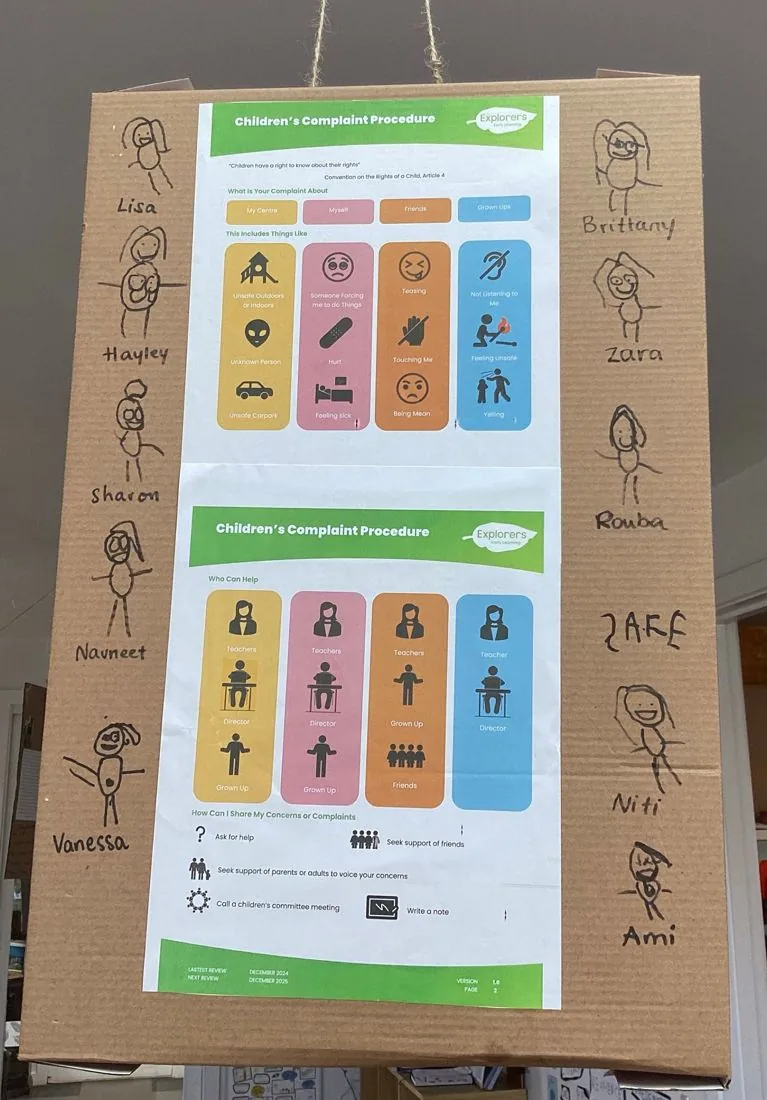
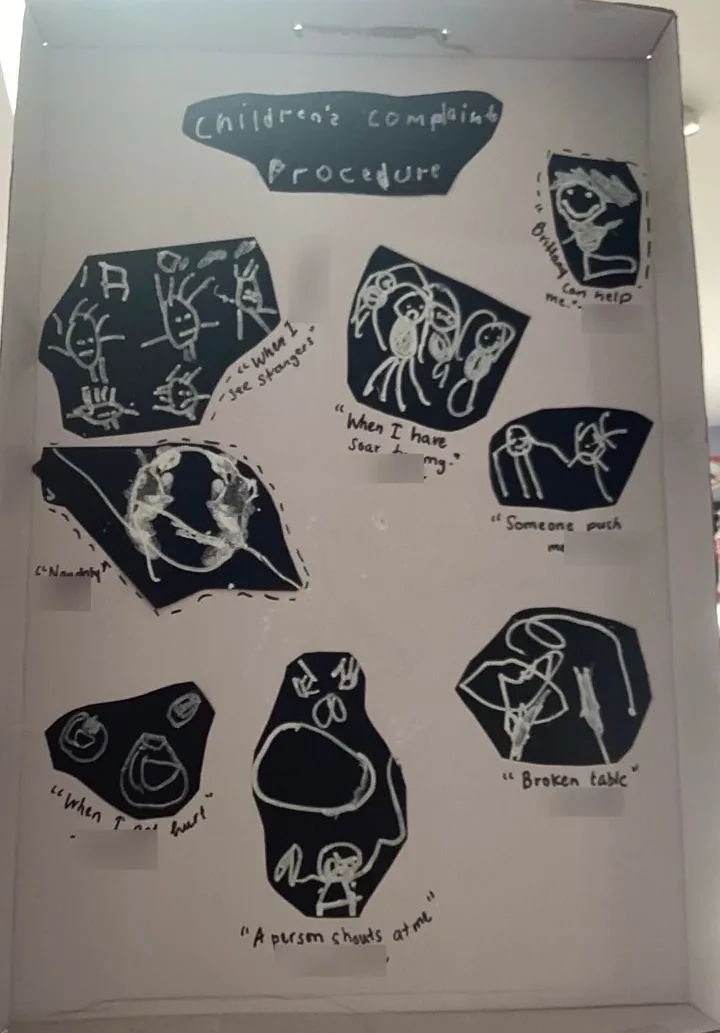
As children grow, so do the conversations. Kinder-age children draw their 5 safe people and practise who they would go to with a worry. They explore the Explorers children’s complaint procedure and learn to sort worries by size:
- A small problem, like “It’s not my turn yet”, is often one they can solve themselves
- A big problem, like “Someone touched me and I didn’t like it”, is always one to tell a safe adult straight away
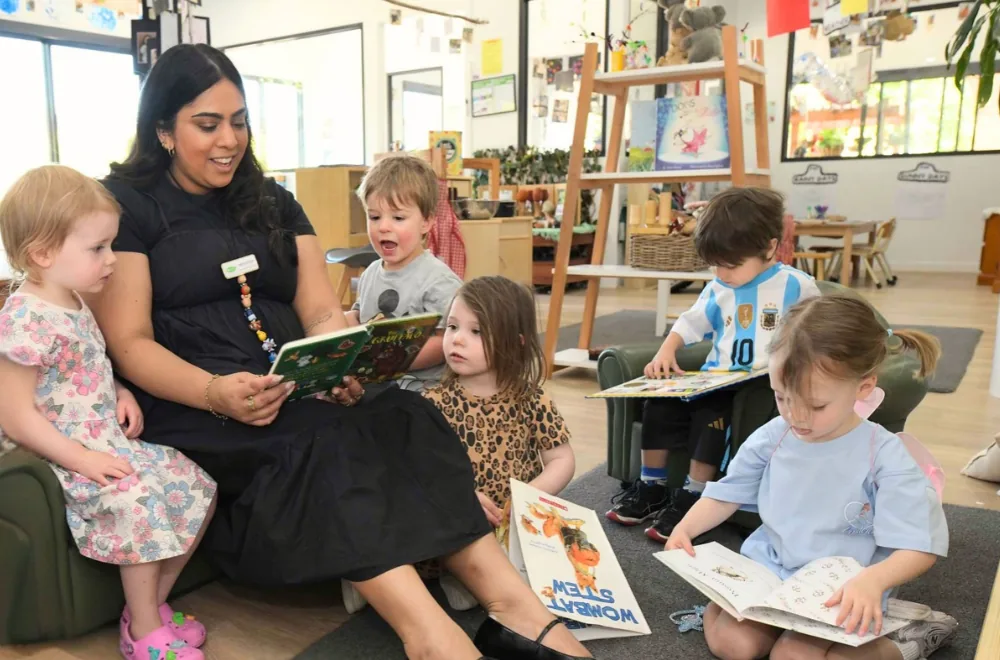
Stories do a lot of the heavy lifting too. Say Something! by Peter H. Reynolds opens up conversations about courage, while I Feel the World by Zanni Louise and Dr Ameika Johnson gives children language for big, prickly feelings.
What’s Happening During Body Safety Week
Each day has its own focus, with experiences for both pre-verbal and verbal children:
- Monday 19 October: Dramatic play with dolls and My 5 Safe People posters
- Tuesday 20 October: Exploring feelings through stories, including Say Something!
- Wednesday 21 October: “Sleeping Bunnies” and learning to speak up and be heard
- Thursday 22 October: Simple Auslan signs and I Feel the World
- Friday 23 October: Educator reflections and Secrets and Surprises by Jayneen Sanders
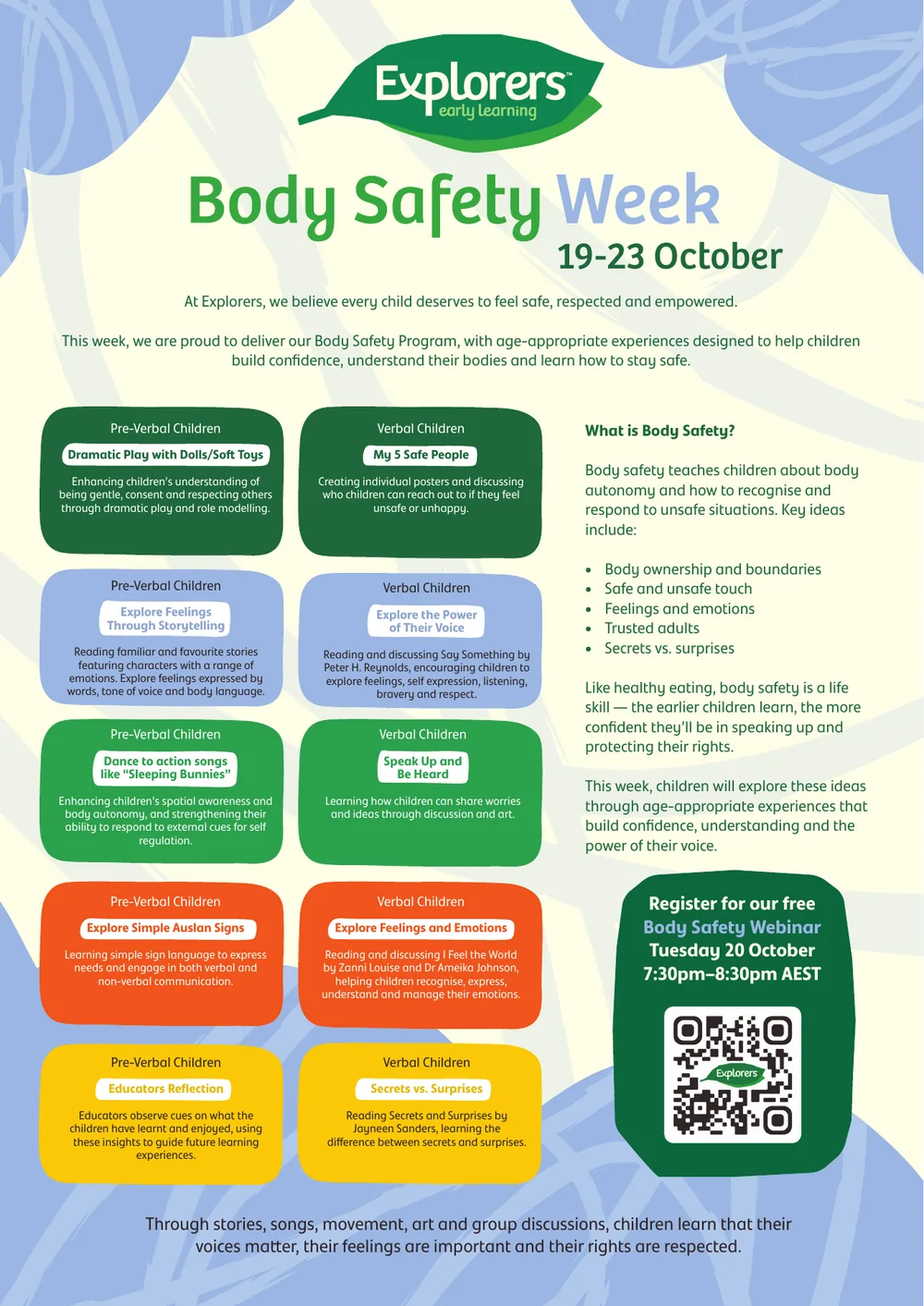
You can view and download the full Body Safety Week poster here (PDF).
Respect is the Foundation
“Our approach to body safety goes hand in hand with how we demonstrate true respect for young children. We see children as capable and holders of rights, whose dignity matters, always. In all interactions with adults, children deserve to have people in their life who take the time to communicate: I see you, I know you, I respect your opinions and preferences, I want you to feel trust and respect, I will let you know what is happening next and guide you through possibilities in expressing your rights and opinions.”
“Children need to first feel safe, trusted and respected, before they can express those things towards others. Laying an expectation of trust and respect through all interactions is the strongest foundation we can create for our collective future.”
Margie Cohen, Head of Pedagogy
Children’s Champions
“Children’s safety, wellbeing and rights are something I am truly passionate about. As a teacher, I always strive to be a ‘Children’s Champion’ and a strong advocate for children’s voices, rights and safety. At Explorers, we approach body safety education in an age-appropriate, respectful and empowering way, supporting children to understand body autonomy, personal boundaries, consent and the importance of speaking up when something doesn’t feel right.”
“Through stories, meaningful conversations and role play, we encourage children to recognise that they are the boss of their own bodies and that their voices matter. I believe Body Safety Week is not just about teaching children how to stay safe, but also about empowering them with the confidence to speak up, say no and seek support from trusted adults. Every child deserves to feel safe, heard, respected and protected. As educators, we have a responsibility to champion these rights every day.”
Brittany Ly, Kinder Teacher, Explorers Williamstown
This year, the children in Brittany’s kinder room created their own version of the children’s complaint procedure, drawing the things they might need help with in their own words.
Secrets vs Surprises
A surprise is something we keep quiet for a little while because it will make someone happy, like a handmade card for Nonna. A surprise always ends with everyone finding out. A secret is something someone asks us to keep hidden, sometimes forever. Secrets can feel heavy or confusing.
People who want to harm children often rely on secrecy. Teaching children that we do happy surprises, not secrets, gives them a clear rule to hold onto: if someone asks you to keep a secret, tell one of your safe people.
Supporting Body Safety at Home
You’re your child’s first and most important safe person. It’s the small, everyday moments that make the biggest difference.
Use the real names for body parts. Correct words give children clear language if they ever need to tell someone something.
Ask first and respect their answer. Try “Can I have a cuddle?” If the answer is no, a high five or a wave works too. Try not to insist on hugs or kisses for relatives.
Name feelings together. Children who can name a feeling find it easier to tell you when something feels wrong.
Make a safe people list. Ask “Who could you talk to if something was worrying you?” and aim for three to five trusted adults.
Swap secrets for surprises. Make it a family rule: “In our family we don’t keep secrets. We do happy surprises.”
Stay calm and listen. If your child tells you something, thank them for telling you and believe them.
Books to Share Together
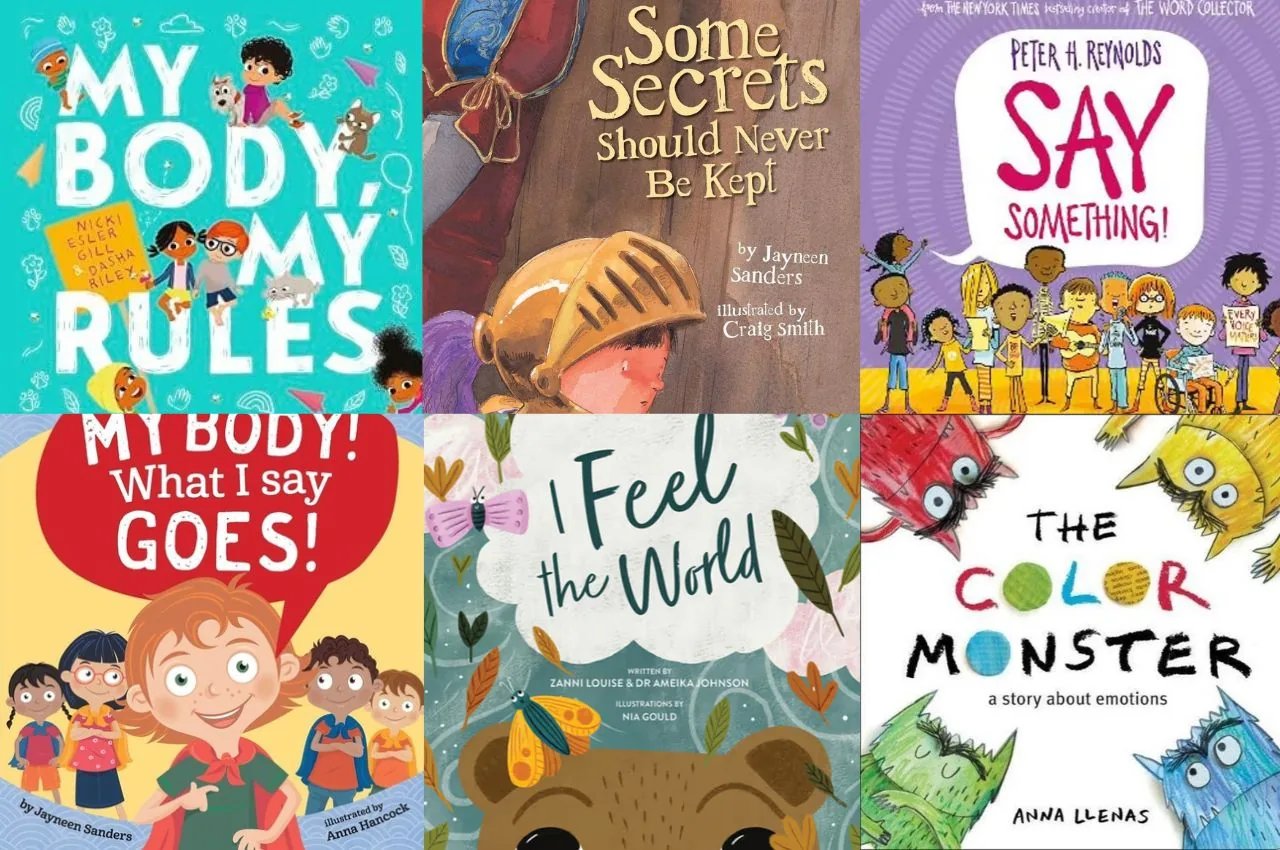
Picture books are one of the easiest ways to open up these conversations. A few favourites from our Body Safety Program:
- My Body, My Rules by Nicki Esler Gill and Dasha Riley
- My Body! What I Say Goes! by Jayneen Sanders
- Some Secrets Should Never Be Kept by Jayneen Sanders
- Say Something! by Peter H. Reynolds
- I Feel the World by Zanni Louise and Dr Ameika Johnson
- The Colour Monster by Anna Llenas
How Explorers Keeps Children Safe
Teaching children about body safety is one part of a much bigger picture. At Explorers, child safety is built into our people, our spaces and our everyday practice in line with the Victorian Child Safe Standards. This includes:
- A Child Safety Leader in every centre
- Working with Children Checks, police checks and annual suitability checks for every team member
- Regular child safety and body safety training
- Open sightlines, internal windows and glass-walled sleep areas
- Visible nappy changes and secure, PIN-access entry
You can read more about our approach on our Child Safety page.
If You Ever Have a Concern
Every concern about a child’s safety is treated as urgent. You can speak to your room leader or centre director, raise a confidential case in the Family Hub or call our Family Support Team on 1300 000 335. If a child is in immediate danger, call 000.